Showing posts with label Foraging Texas. Show all posts

05 June 2013

More Yummy Berries to Forage in Austin


Ehretia anacua 
Anacua, Sugarberry Anacua, Knockaway, Sandpaper Tree

It has mildly sweet fruit like hackberry, but with more flesh and less seed. It's a popular ornamental in Texas as it is hardy in dry areas.  It has white blooms, typically beginning in April. It has two-seeded berries that ripen in early summer and transition from yellow to bright orange or even red.  The tree may die back in cold winters.  It has mildly sweet fruit like hackberry, but with more flesh and less seed. It's a popular ornamental in Texas as it is hardy in dry areas.  It has white blooms, typically beginning in April. It has two-seeded berries that ripen in early summer and transition from yellow to bright orange or even red.  The tree may die back in cold winters.  
Growing Conditions
Native Habitat:  Thickets, Open Woodlands, Chaparral & Brush Country, Fence Rows.Water Use: Needs a good deal originally, then very drought tolerant.  
Soil Moisture: DryCold Tolerant: Yes, but may die back in cold winters. Does not bloom/fruit well in N. Texas.Soil Description: Well-drained, alkaline soils; Sandy, Sandy Loam, Medium Loam, Clay Loam, Clay.Not a true evergreen as it replaces it's leaves in the early spring.  

Ornamental Use: Attractive, Aromatic, Showy, Blooms Ornamentally.  Deep shade; spring blooms appear that the tree is snow-covered.  Has unusual mature trunks that look like several corded trunks bound together.
This 20-45 ft. perennial evergreen is from the Borage Family, native to the area, and know as Sugarberry.  It is the Anacua (Ehretia anacua) and is at/near the northern limit of its natural range in Austin. 

BenefitWildlife: Anaqua blossoms attract honeybees as it is a nectar source.

Photo from http://www.esacademic.com/

The fruits attract numerous birds, mammals and hippies. 

Photo Courtesy of Dave's Garden

Larval: Exclusive host for larvae and adult Anacua Tortoise Beetle (Coptocycla texana).

If you have a favorite foraging food in Austin, share it and we will do a write up on it.


15 May 2013

Broad-leaf Cattail or Bulrush - It's What's for Dinner


Any coverage of edibles in Texas should include the pervasive Cattails.  The type most often seen in this area are Typha latifolia, the Broad leaf Cattail or Bulrush.  It's a perennialherbaceous plant native in all states in the U.S., excluding Hawaii where it is considered a noxious weed and is not native.  It typically grows in water less than 2.6 feet deep.

Photo: www.discoverlife.org
Warning: Cattail roots should not be eaten raw!  

They are remarkable at pulling toxins from water sources.  If the plants are growing in polluted water, don't use cattails for food.  Runoff from roads, lead from auto exhaust and pesticides are all possible sources of contamination.  

They can be harvested in any season.  Researchers at Syracuse University found that they furnish calcium and their starch contains as much protein as corn or rice and more carbohydrate than potatoes.  

Join Rosalee and Xavier de la Foret as they venture into a Cattail swamp to demonstrate how to harvest and prepare Cattails.  This is the first video of 6 very interesting videos in their series of Cattail preparation videos:


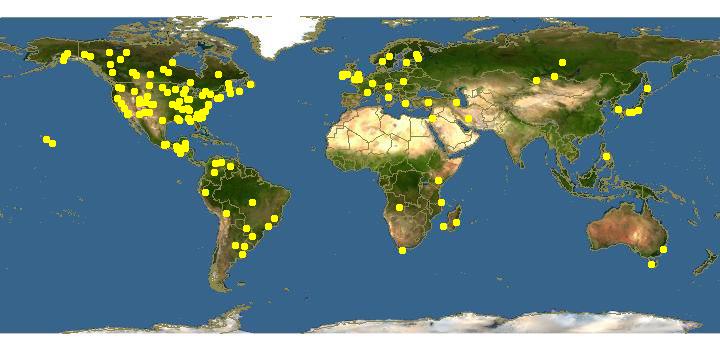
A map of where Typha latifolia can be found. 
(sourced at www.discoverlife.org)

The flower spikes resemble corn dogs placed end to end.  The top cluster is of male flowers and the bottom cluster, females.  Remove the papery sheath surrounding the flowers.  Boil the clusters for a few minutes, and you can eat them like corn on the cob, coated with goat butter.  Cattail-on-the-cob's core of the cluster is hard and inedible.  

KingdomPlantae         Division: Magnoliophyta 
                Class: 
Liliopsida 

                        Order: Typhales                                 Family: Typhaceae                                         Genus: Typha L.                                                Species: Typha latifolia                                           ScientificName                                                   Typha latifolia                          
Common Name                                               Broad leaf Cattail     

Resources:                                           
http://eol.org/pages/526590/overview

12 May 2013

Exploring the Many Uses of Our Local Plants - Turk's Cap


LOCAL AND NATIVE PLANTS OF AUSTIN AND THE HILL COUNTRY

Seeking out Plants for Gardens, Permaculture and Food Forests


It's getting easier to find more information on plants in general for Texas and for our area specifically.  We reside in the Austin/Hill Country region. But to get past general and into the more nitty-gritty, it takes some diving into books and finding multiple sources to confirm the edible, the raw material, the medicinal and the other many wonderful uses of plants. It also takes a bit of care. Closely related plants don't necessarily have the same qualities.  While some are edible and nutritious, their close cousins are poisonous. Not all websites and books give the necessary specifics.  Always check numerous references and learn how to test plants for toxicity even when you think you have properly identified a "safe" plant to eat. 

I've found a few wonderful resources, so I thought I'd share specific native plants of this region (as well as those that are well-adapted to thrive here) and what I've learned about them. I'm starting with a plant that, while it plants itself just fine, is planted in abundance by home and business owners en mass, as well.


Turk's Cap (Malvaviscus arboreus var. drummondii)

Turk's cap is a native plant with edible flowers, leaves and berries.
Several nurseries in Austin sell Turk's Cap.
The image above is from Countryside Nursery

This marvelously resilient plant is beloved for many reasons, not the least of which is its small, hibiscus-like red bloom that hummingbirds and butterflies flock to. There's so much sweet nectar waiting at the end of the flower that they're a treat for people as well.  Just pluck off the flower and munch away or sip the nectar from the plucked end. If you've ever had a tasty hibiscus tea, you'll appreciate the similar qualities of a Turk's Cap tea. It blooms most of the year and even in partial shade--it's just a super-handy plant!


The young leaves are touted by both Mark "Merriwether" Vorderbruggen (from Merriwether's Guide to Edible Wild Plants of Texas and the Southwest) and Delena Tull (author of the wildly useful book Edible and Useful Plants of Texas and the Southwest) as being great fresh, especially mixed in salads. Turk's Cap leaves also stand up well to similar treatment as spinach: steaming, cooking into quiches and frittatas and dressing up familiar dishes such as pastas and pizzas. The tender leaves are in greatest abundance in Spring, but any new flush of leaf growth will have some tender nibbles.


While the Merriweather's guide recommends making a tea from the edible, red-ripe berries, Tull gives a full recipe for Turk's Cap Jelly. While the berries are edible fresh, the seeds dominate the berries, so you get more flavor and food from making something out of the berries instead of just munching them raw. In the Austin and Hill Country area, berries ripen primarily in summer and fall.


So even if you're not ready to commit to a full permaculture or food forest landscape, you won't get fuss from the neighbors for adding this lovely, well-known and versatile native plant to your garden!


A note for those following outside of Texas: Turk's Cap is found growing natively from Texas East to South Carolina and on down to Florida.


Resources and further reading

Information on Turk's Cap used for this article can also be found here:

"Edible and Useful Plants of Texas and the Southwest" by Delena Tull.
Foraging Texas: Turk's Cap
Lady Bird Johnson Wildflower Center Native Plant Database: Turk's Cap
USDA Plants Database: Malvaviscus arboreus Dill.