Any coverage of edibles in Texas should include the pervasive Cattails. The type most often seen in this area are Typha latifolia, the Broad leaf Cattail or Bulrush. It's a perennial, herbaceous plant native in all states in the U.S., excluding Hawaii where it is considered a noxious weed and is not native. It typically grows in water less than 2.6 feet deep.
They are remarkable at pulling toxins from water sources. If the plants are growing in polluted water, don't use cattails for food. Runoff from roads, lead from auto exhaust and pesticides are all possible sources of contamination.
They can be harvested in any season. Researchers at Syracuse University found that they furnish calcium and their starch contains as much protein as corn or rice and more carbohydrate than potatoes.
Join Rosalee and Xavier de la Foret as they venture into a Cattail swamp to demonstrate how to harvest and prepare Cattails. This is the first video of 6 very interesting videos in their series of Cattail preparation videos:
The flower spikes resemble corn dogs placed end to end. The top cluster is of male flowers and the bottom cluster, females. Remove the papery sheath surrounding the flowers. Boil the clusters for a few minutes, and you can eat them like corn on the cob, coated with goat butter. Cattail-on-the-cob's core of the cluster is hard and inedible.
 |
| Photo: www.discoverlife.org |
Warning: Cattail roots should not be eaten raw!
They are remarkable at pulling toxins from water sources. If the plants are growing in polluted water, don't use cattails for food. Runoff from roads, lead from auto exhaust and pesticides are all possible sources of contamination.
They can be harvested in any season. Researchers at Syracuse University found that they furnish calcium and their starch contains as much protein as corn or rice and more carbohydrate than potatoes.
Join Rosalee and Xavier de la Foret as they venture into a Cattail swamp to demonstrate how to harvest and prepare Cattails. This is the first video of 6 very interesting videos in their series of Cattail preparation videos:
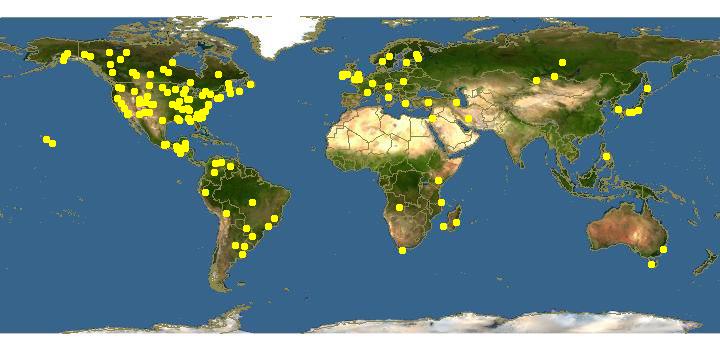 |
| A map of where Typha latifolia can be found. (sourced at www.discoverlife.org) |
The flower spikes resemble corn dogs placed end to end. The top cluster is of male flowers and the bottom cluster, females. Remove the papery sheath surrounding the flowers. Boil the clusters for a few minutes, and you can eat them like corn on the cob, coated with goat butter. Cattail-on-the-cob's core of the cluster is hard and inedible.
Kingdom: Plantae Division: Magnoliophyta
Class: Liliopsida
Order: Typhales Family: Typhaceae Genus: Typha L. Species: Typha latifolia ScientificName Typha latifolia
Common Name Broad leaf Cattail
Resources:
Class: Liliopsida
Order: Typhales Family: Typhaceae Genus: Typha L. Species: Typha latifolia ScientificName Typha latifolia
Common Name Broad leaf Cattail
Resources:
http://eol.org/pages/526590/overview
http://www.discoverlife.org/mp/20m?map=Typha+latifolia
USDA Plants Database: Typha latifolia L.
Lady Bird Johnson Wildflower Center Native Plant Database
Edible and Useful Plants of Texas and the Southwest, Delena Tull
http://en.wikipedia.org/wiki/Typha_latifolia
USDA Plants Database: Typha latifolia L.
Lady Bird Johnson Wildflower Center Native Plant Database
Edible and Useful Plants of Texas and the Southwest, Delena Tull
http://en.wikipedia.org/wiki/Typha_latifolia
